
Dec. 14 – Moscow
The Luzhniki sport complex looks tired anyway. But add wet snow and gloomy skies above, and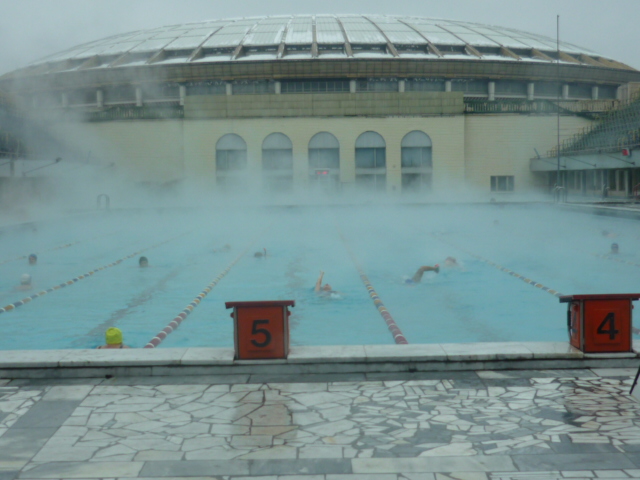 take away all the people, and it’s a completely somnolent landscape. Big structures all hunkered down for the winter. At the entrance, I guessed right (which was wrong) and went past the Ice Palace where the 1972 Summit Series took place, past soccer pitches, running tracks, a driving range. I crossed vast, empty parking lots and then back around the big, beige Olympic Stadium before finally getting to the Olympic pool.
Here is how the pre-swim went:
- Go to the window to pay. Clerk scribbles “11:40”. A ten-minute wait.
- At 11:40, go back to pay, slide my passport and 300 Rubles ($10) through the slot. Clerks says “spravka”. I shrug my shoulders, she gives my back my passport and money. Nyet so far.
- I remember that at many Russian pools, swimmers must present some kind of certificate of physical fitness, and that this can be obtained on site.
- I wander the halls, and find a door with a red cross on it. Inside is an idle old man (a physician? a nurse?) in a white smock. I say “spravka?” hopefully. He nods wearily, looks at my passport, asks me some questions I don’t understand. I respond in English anyway. He takes a slip of paper, stamps and signs it, and gives it to me.
- Back at the window for a third time, I slide money, passport and oh-so-important “spravka” in. Success! I’m given a plastic claim tag.
- Across from the cash is a coat check. I leave my jacket there and get another plastic claim tag.
- I enter a corridor looking for the men’s changeroom, but find only the ladies’. At length, I’m directed to the other side of the pool.
- Before entering the changeroom, I’m made to remove my boots and put them in a plastic bag. Then, in exchange for the first claim tag, I get a locker key from yet another attendant.
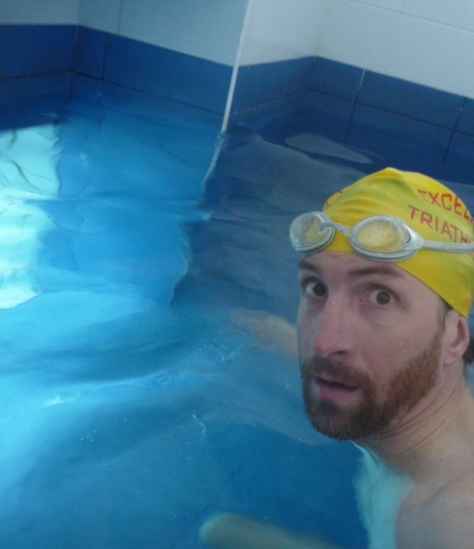
About to swim towards the light.
The pool is being renovated, and the change and shower facilities are clean and new. Access to the pool itself requires a baptism of sorts. Down some steps into the water, then underwater through a small gate and channel. A bit freaky, but keeps people from getting cold – it is an outdoor pool. Steam rises from the water as I swim, looking at the tiles on the bottom. It’s not crowded. Women and men stick to separate halves. Between lengths, I look up at the empty grandstands, and beyond at the Olympic Stadium’s roof. I decide not to put myself through a virtual challenge against the 1980 East German women’s swim team. Swim over, I go through the multiple-tag-returning procedure in reverse.
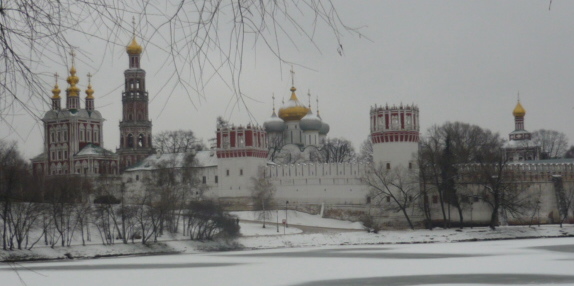 I walk along the silent, dark Moskva to the Novodevichy convent and cemetery. A UNESCO site, the convent is high-density worship. Inside the walls are four onion-domed churches, and one cathedral. The cemetery is the final resting place for Russian notables. Khrushchev and Yeltsin, not considered worthy of burial in the Kremlin, are here. Tourists enter, camera at the ready, as if they’re on some kind of famous, dead Russian safari. But it’s much too miserable and soggy to spend much time among tombstones. I’d rather be buying groceries, and leave.

