Vancouver 2010: My White Board of Olympic Truth

This February’s ten-year “Vaniversary” is a significant one for 2010 Gamers. I suspect it will be for the rest of our lives.

On social media I’m seeing plenty of photos showing the Games’ successes: group shots of smiling faces; cheering fans; packed venues; blue skies and white mountains. I wish I had taken more of those myself in 2010. But instead, I scrawled the remarkable utterances of colleagues on a white board in my cubicle.

I’m glad I did. To me these words, delivered unprompted by people under stress and “off-camera”, reveal what being part of a great undertaking – Olympic or otherwise – is really like.

Results Are Not Guaranteed

“We know the Games are going to happen. We just don’t know how, yet.”

“We are so guessing here, and it’s Christmas.”

In retrospect, success can appear inevitable. But in Vancouver there was little pre-Games enthusiasm in the city, athlete Nodar Kumaritashvili died on the first day, there were Opening Ceremony embarrassments, and no snow on Cypress Mountain. Despite years of diligent and relentless planning, training, testing and contingencies, a positive outcome seemed very much in doubt and we all sweated.

You Pay With Your Body

“I need, like, 30 days of yoga.”

“For the love of God, would somebody please get him some coffee?”

No sleep, sitting hunched in front of your computer screen, for infinity. On occasion, a colleague puts food in front of you, which you mechanically slurp down in a few moments before getting back to work. Obsession and commitment are like that, and for a while your body can take it. Just know that when the project ends, your constitution will implode.

You Lose Your Mind

“I got eyes in my tears.”

“It’s not shit! It’s water!”

“After years. Like, fuck, you know?”

Profanity. Difficulties with concentration and memory. Shortened fuses. Stress, in short. On the hard road to glory, something happens to your brain. In my case, during the Games I had very little short-term recall of what I had written (and I managed communications!) or where I had been. Fortunately, this caused no critical failures. But in stretching your limits, you may not recognize yourself. Or always like what you see.

You Are Not Always Great

“We’re leaving it in because nobody can check, and it’s useless information.” 

“Delegations do not transfer to the Opening Ceremony in alphabetical order. They transfer in disorder.” [This statement was delivered tongue-in-cheek to the delegations, but there was a well-understood element of gallows humour about a very tricky process].

“Emptied cardboard bins. Dealt with mice presence.”

Overall, and with justification, praise was heaped on the Vancouver Games. But every Gamer has a story of a shocking screw up. Mine include an embarrassing and hurried mass re-print because I put the Olympic logo on a Paralympic publication. If a project involves humans – even competent ones – things will go wrong. But the Games go on.

But doing a job well, with others, for others, is great!

Before I was hired, during my interview I asked my future boss:

“Is there anything you’re glad I haven’t asked you about being part of the Games?”

On the video conference screen, she though for a moment, grinned, and said:

“It’s going to be a lot of work.”

She did me a favour with her frankness, which prepared me for what was to come.

Like everyone who worked or volunteered in Vancouver and Whistler, I was hired to deliver an excellent experience for the world’s athletes and for Canadians. That came at a cost I’ve described above and we all paid it.

But as those posts and reunions demonstrate, there is a lasting pride in a job well done and friendships forged by a remarkable experience.

That, for me, is the Vancouver 2010 legacy.

Sikh Wedding Rookies

If you want to have a good time in a friendly and festive atmosphere, while having no real idea what’s going on, go to a Sikh wedding.

Photo: F. Loek

Photo: F. Loek

This weekend, a group of us attended the nuptials of our good friend. Since he has no relatives in Canada, we are his “Canadian family”, he said. The reception was on a snowy Friday night. And on a cold clear Sunday morning, the ceremony happened at the temple (known as a Gurudwara).

If you want to learn more about the religion, look elsewhere. Also, my observations are not necessarily representative of what “normally” happens. In fact, I understand these were abridged proceedings. All the same, here’s a cheat sheet on what you might expect.

I don’t understand, but it’s okay: let’s face it. You’re not just here because of your friend, but because you’re curious about Sikh customs. So accept your ignorance and go with the boisterous flow. The Sikhs were friendly and welcoming at every turn – and you’re just as likely to encounter a Canadian accent as an Indian one. The language spoken during the ceremony was Punjabi, but a helpful translation of the chants was projected on the temple wall. All in, we were there for 3.5 hours, of which maybe one hour was the official part, and the rest was eating, standing around not sure what to do with ourselves, or chatting.

Are you sitting down?: During the ceremony you will be, on a clean, carpeted floor. Cross-legged, or semi-kneeling, for an extended period.

Wear ‘em if you got ‘em: Many of the women in our group seized the opportunity to put on the bright, silky saris languishing underused in their closets. Or they borrowed or bought one. They certainly fit right in among the kaleidoscopically resplendent Indian women. The tactical considerations were few; “That was easier than I expected” said one sari-wearer upon returning from the washroom. And plan on being noticed on the way to or from the event, as in “You could have had anyone at that gas station”.

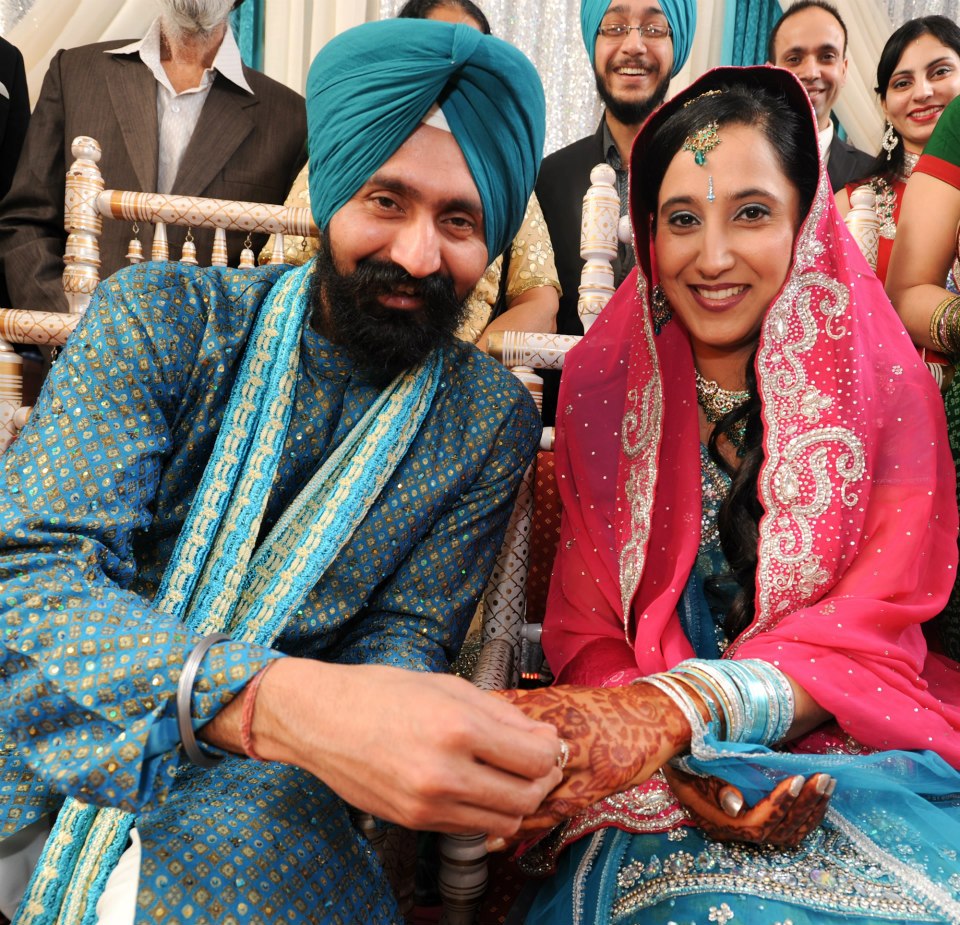
As for the gents, the only ceremonial garb was worn by the groom, magnificently matching his bride in turquoise at the reception, and magenta at the ceremony. Wear a standard suit, but live a little and put on a bright tie.

Photo: A. Halliop

Photo: A. Halliop

Heads and feet: in the temple, heads must be covered and shoes removed. The women all wore shawls, the men a kerchief supplied by the Gurudwara. One of our ladies (luckily not the bride) got cold feet. Chivalrously, one of the guys gave her his socks.

Eat, then eat again: before the ceremony, we ate a meal, seated on the carpeted floor at the temple. After the ceremony, we were directed to the post-wedding meal. But we didn’t quite understand and went back to eat more of the same food before amused Sikhs ushered us to a different dining hall where we had….more food.

BYOB: Certainly no alcohol at the temple. At the reception hall, alcohol was not served but it was permitted. Clandestine and not-so-clandestine bottles made their way around the non-Indian tables. There were no slurred excesses, but liquid courage fired up some of the dancing later on.

Hot, hot, heat: She’s red-faced and sweating, dutifully chewing through the spicy food on her plate. Martyrdom isn’t necessary, however. Both at the reception and ceremony, the meals (all vegetarian) were served buffet-style. If you have a sensitive palate, you can discreetly avoid the spicier dishes or set them aside.

Photo: F. Loek

Photo: F. Loek

Drop it in their laps: beforehand, we consulted with the bride and groom and agreed that gift cards to major housewares suppliers would be our contribution. This gift-giving happened at the reception. While the bride and groom sat side-by-side on a dais, guests filed past to present their envelopes, which piled up on their laps. It was also common for dollar bills of varying amounts to be given.

Photo and film: other than during the actual ceremony, we clicked at will. There was the inevitable video production crew to film the entire event, as well as the official photographer. The latter had a minor contretemps with one of our gang (also a pro photog) over some equipment interference. But they reconciled. As our guy said, “If I had been in his situation, I would have lost it!”.

Bust a Bhangra move: the heavy thumping beat of Indian pop is familiar to western ears. Just add in a few hand gestures: the “screwing in a lightbulb overhead”, the “hitchhiker”, the “cowabunga”, and you’re all set. And yes, you will do Gangnam style, Punjabi style.

Photo: F. Loek

Photo: F. Loek